
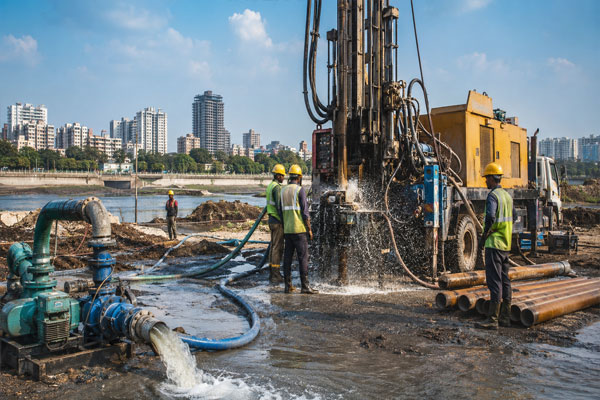
Dewatering Borewell Drilling Ahmedabad
Construction and industrial projects often face water accumulation during excavation, foundation work and underground development. Excess water can weaken the soil, delay construction and create unsafe working conditions. Professional dewatering services help remove unwanted groundwater and keep the project area stable and workable.
Quality Borewell provides dewatering and borewell drilling support in Ahmedabad for residential, commercial, industrial and infrastructure projects. Our team studies the site condition, excavation depth, groundwater level and soil type before recommending a suitable solution.
What Are Dewatering Services?
Dewatering is the process of removing groundwater or collected water from a construction site, basement, foundation pit, trench or industrial area. The main purpose is to create a dry and stable environment for excavation and construction work.
Dewatering may be required before or during:
- Basement construction
- Foundation excavation
- Industrial shed development
- Pipeline installation
- Underground tank construction
- Road and bridge projects
- Lift pit construction
- Drainage work
- Commercial building projects
- Infrastructure development
Why Is Dewatering Important for Construction Projects?s
Water inside an excavation area can affect both safety and project quality. If it is not controlled properly, the surrounding soil may become soft or unstable.
Professional dewatering supports the project in several ways.
Creates a Dry Working Area
Removing water allows workers and machinery to operate safely inside excavation pits and foundation areas.
Improves Soil Stability
Controlled groundwater removal helps reduce soil movement, loose formation and collapse around the excavation.
Supports Better Foundation Work
Concrete and foundation activities require suitable site conditions. Dewatering helps prepare the area for reinforcement, shuttering and concrete placement.
Reduces Project Delays
Continuous water accumulation can stop construction work. A planned dewatering system helps maintain regular progress.
Protects Equipment and Materials
Pumps, electrical equipment, reinforcement steel and construction materials may be affected by standing water. Dewatering helps reduce this risk.
Types of Dewatering Methods
The correct dewatering system should be selected only after understanding the site condition.
Open Pumping Dewatering
In this method, water is collected in a pit or sump and removed using a pump. It is generally suitable for shallow excavations where water inflow is limited and the soil remains stable.
Sump Dewatering
Small channels are created to direct water toward a collection sump. The collected water is then pumped outside the excavation area.
This method is commonly used for foundation pits, lift pits and small construction sites.
Wellpoint Dewatering
A series of small wellpoints is installed around the excavation area and connected to a common suction pipe. This method helps lower the groundwater level around the site.
Wellpoint dewatering may be suitable for sandy soil and construction projects requiring continuous groundwater control.
Deep Well Dewatering
Deep wells are drilled around the project area and fitted with submersible pumps. These wells remove groundwater from greater depths.
Deep well dewatering is commonly considered for deep basements, large foundations and major infrastructure projects.
How Borewell Drilling Supports Dewatering
Borewell drilling plays an important role in deep dewatering projects. Borewells are created around or near the excavation area to lower the surrounding groundwater level.
The process generally includes:
- Site inspection and groundwater assessment
- Selection of suitable borewell locations
- Drilling to the required depth
- Installation of casing pipes
- Placement of suitable dewatering pumps
- Continuous removal of groundwater
- Monitoring of the water level
- Adjustment of pumping capacity when required
Why Choose Quality Borewell?
Quality Borewell provides practical groundwater management, dewatering and borewell drilling solutions based on actual site conditions. As experienced borewell drilling contractors in Ahmedabad, our team supports residential, commercial, agricultural, industrial and construction projects with site-specific planning and reliable field execution.
We have extensive experience in borewell drilling services, construction dewatering services, deep borewell dewatering, groundwater recharge, recharge well construction, percolation well development, rainwater harvesting, tubewell drilling, borewell inspection, borewell cleaning and pump repair services. Before recommending a solution, we assess the soil condition, groundwater level, drilling depth, water inflow, excavation requirement and project location.
Frequently Asked Questions
Dewatering is the process of removing groundwater or collected water from an excavation, foundation pit, basement or construction area.
It is required when groundwater or rainwater enters the working area and affects excavation, foundation or underground construction work.
The suitable method depends on excavation depth, soil type, groundwater level, water inflow and project size.
Yes. Deep borewells fitted with suitable pumps can help lower groundwater around large or deep excavation sites.
The number depends on the project area, excavation depth, geological formation and groundwater pressure.
The duration depends on the construction stage and groundwater condition. Some projects require continuous pumping until underground work is completed.
Submersible, centrifugal, wellpoint or other suitable pumps may be used according to water depth, discharge and site conditions.
Dewatering support can be provided for factories, warehouses, industrial sheds, machine foundations and infrastructure projects in Ahmedabad.
A properly designed system can help control groundwater and improve soil stability. However, excavation support and structural safety measures may also be required.
Site inspection helps understand groundwater level, soil type, excavation depth and water inflow before selecting the dewatering method.