
In many parts of India, finding enough water is becoming a big challenge. As our cities grow and concrete construction increases, rainwater cannot soak into the ground naturally. Instead, it flows away into drains and gets wasted. This causes underground water levels to drop every year. A Percolation Well in Ahmedabad is one of the best ways to solve this problem. It is a smart rainwater recharge system designed to collect rainwater and send it deep into the earth to refill drying aquifers and improve groundwater levels.
At Quality Borewell, we understand that water is our most precious resource. By installing a percolation well, you are not just saving water for today, but you are also securing water for the future. These wells act like a bridge between the sky and the ground, ensuring that every drop of rain helps improve the water level in your area. This is especially important in Gujarat, where we rely heavily on groundwater for our homes, farms, and factories.
What is a Percolation Well?
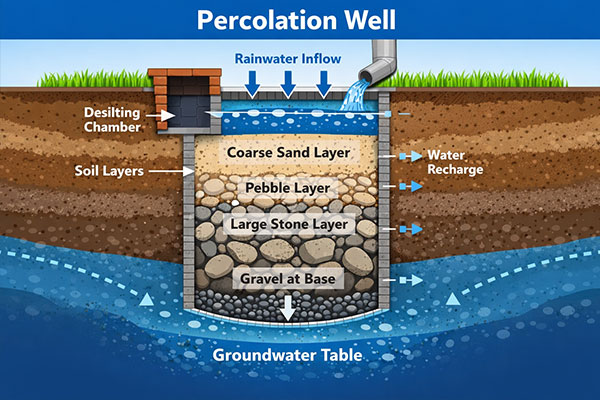
A percolation well is a specially designed pit or hole in the ground used to recharge groundwater. Unlike a regular well where we take water out, this well is used to put water back in. Its main purpose is to capture surface runoff which is the water that flows on the ground during rain and let it seep slowly into the soil layers.
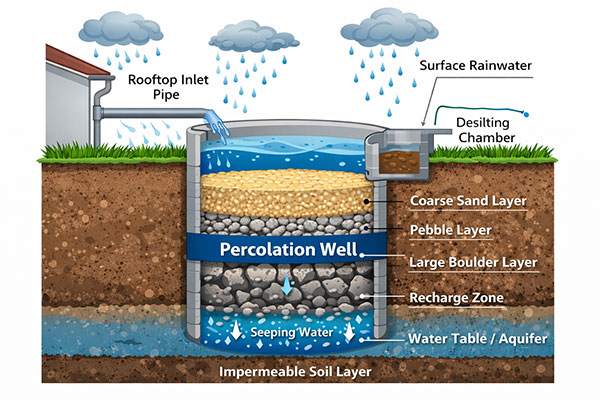
When it rains, the water enters the percolation well through an inlet. Inside the well, there are layers of natural filters like stones and sand. As water passes through these layers, it gets cleaned and eventually reaches the underground water table. This process is much better than letting water sit on the surface, where it might evaporate or become dirty.
Why Percolation Well is Important in India
India faces a serious water crisis. In most Indian cities and villages, we are pumping out water much faster than nature can put it back. This has led to many borewells going dry. Here is why a percolation well is the need of the hour:
- Falling Water Tables: In states like Gujarat, Rajasthan, and Maharashtra, the water level is dropping by several meters every year.
- Concrete Jungles: Because of roads and buildings, the ground is “paved over.” Rainwater has no place to sink into the soil.
- Preventing Waste: Billions of liters of fresh rainwater flow into salty oceans or dirty sewers every monsoon.
- Government Focus: The Indian government is now making rainwater harvesting and percolation well systems mandatory for new buildings to prevent a future water “day zero.”
Benefits of Percolation Well
Installing a percolation well offers many long-term advantages for property owners and the environment:
- Permanent Water Solution: It helps keep your nearby borewells charged so they don’t run dry in the summer.
- Improves Water Quality: By adding fresh rainwater to the ground, it reduces the saltiness (TDS) of the existing groundwater.
- Environmentally Friendly: It is a natural way to manage water without using chemicals or electricity.
- Very Low Maintenance: Once built, it requires very little work to keep it running for decades.
- Prevents Flooding: By soaking up excess rain, it prevents water-logging in your society or backyard.
- Versatile: It can be built anywhere – from a small house to a massive industrial park.
Percolation Well Construction Process
Building a percolation well requires expertise to ensure the water actually reaches the right soil layer. Here is our simple step-by-step process:
- Site Inspection: We look at the slope of your land to see where the rainwater naturally collects.
- Soil Analysis: We check if the soil is sandy (which absorbs water fast) or clay-heavy (which is slow) to decide the well’s design.
- Digging: A pit is dug to a specific depth. The diameter and depth depend on how much roof area or ground area you have.
- Filter Media Layers: We fill the well with layers. Usually, big boulders go at the bottom, followed by smaller pebbles, and then a thick layer of coarse sand on top.
- Water Inlet: We connect your rooftop pipes or ground drains to the well. A “desilting chamber” is often added to catch mud before it enters the main well.
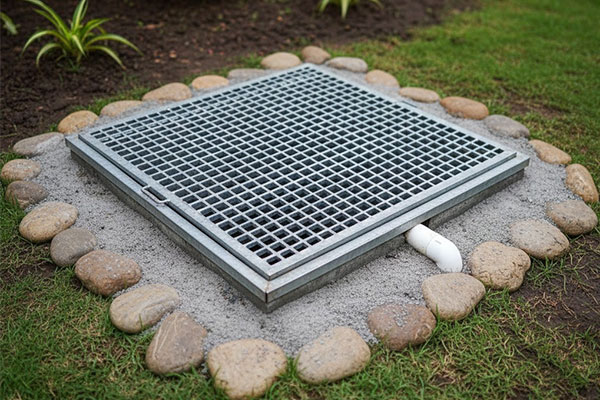
- Safety and Finishing: The well is covered with a strong RCC (cement) slab or a heavy-duty grill to ensure no one falls in.
Ideal Depth and Size of a Percolation Well
The size of a percolation well is not “one size fits all.” It depends on your specific needs:
- Depth: Most wells are between 10 to 30 feet deep. However, if the soil is very hard, we may need to go deeper to find a “permeable” layer that accepts water.
- Rainfall: In areas with heavy monsoon rains, we build larger wells to handle the high volume of water quickly.
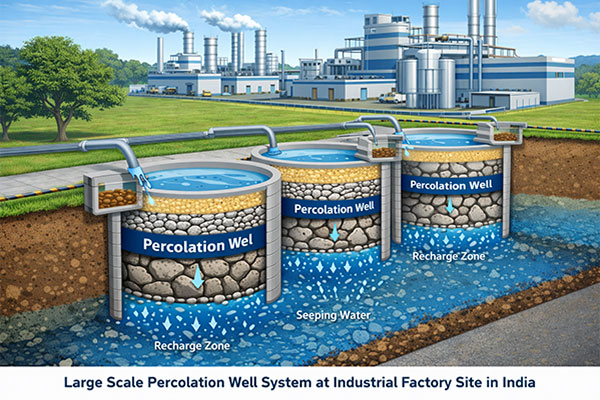
- Area: A large factory will need a much bigger or multiple percolation well units compared to a small residential bungalow.
Difference Between Borewell and Percolation Well
While they might look similar, their jobs are completely opposite. A borewell is like a straw used to drink water from the ground. A percolation well is like a funnel used to pour water back into the bottle.
Comparison Table
| Point of Comparison | Borewell | Percolation Well |
|---|---|---|
| Primary Purpose | To extract water for use | To recharge groundwater |
| Direction of Water | Bottom to Top | Top to Bottom |
| Depth | Very deep (200ft to 1000ft+) | Shallow (10ft to 40ft) |
| Maintenance | Requires pump repairs | Requires filter cleaning |
| Components | Motor, pipes, casing | Stones, sand, filter media |
Where Percolation Well is Used
A percolation well can be installed almost anywhere there is open space or a roof:
- Residential Societies: To keep garden borewells active and prevent local flooding.
- Factories: To meet environmental norms and reuse the massive amount of water from factory sheds.
- Farms: To ensure that irrigation wells have enough water during the dry winter months.
- Roadsides: Municipalities use them along highways to prevent water from standing on the roads.
Percolation Well Cost in India
- The cost of a percolation well depends on several factors. Because every site has different soil, the price is not fixed.
- Depth and Diameter: A deeper and wider well requires more labor and more filter material.
- Type of Filter Media: The quality of stones and sand used affects the price.
- Location: If the site is hard to reach for digging machinery, the cost may go up.
- Long-Term Savings: While there is an initial cost, it saves you money in the long run by preventing the need to dig new borewells or buy water tankers.
Maintenance of Percolation Well
To keep your percolation well working for a long time, follow these simple steps:
- Pre-Monsoon Cleaning: Every year in May, remove the top layer of sand and clean out any settled silt or mud.
- Filter Replacement: Every few years, you might need to replace the top layer of sand to keep the filtration speed high.
- Check Inlets: Ensure that the pipes bringing water to the well are not blocked by leaves or plastic trash.
Why Choose Quality Borewell for Percolation Well
Quality Borewell is a trusted name for percolation well and groundwater recharge solutions with 50 years of field experience. Our experienced team understands different soil conditions, water levels, drilling depth, rainwater flow, and site requirements before starting the work.
- Expert Knowledge: We don’t just dig holes; we understand Indian soil and geology.
- Quality Materials: We use the best grade of stones and sand to ensure your well doesn’t get blocked.
- Proper Planning: We calculate the exact size you need based on your area’s rainfall patterns.
- Reliable Service: Our team is trained to complete the work safely and cleanly.
Percolation Well Details
| Feature | Description |
|---|---|
| Main Function | Recharges aquifers through natural filtration |
| Best Location | Low-lying areas or near rainwater downpipes |
| Filter Materials | Boulders, aggregates, and coarse sand |
| Typical Lifespan | 20+ years with basic maintenance |
| Water Source | Rainwater and surface runoff |
FAQ Section
How deep is a standard percolation well?
In most Indian conditions, a percolation well is between 15 to 30 feet deep. The exact depth depends on when we hit a layer of soil that can easily absorb water.
Does a percolation well require a lot of space?
No, it is very compact. Usually, a 5-foot by 5-foot area is enough for the surface opening, though the underground pit might be slightly larger.
Is it different from a rainwater harvesting system?
A percolation well is actually a type of rainwater harvesting system. While some systems store water in tanks, this system stores it directly in the ground.
How often should I clean my percolation well?
You should check and clean the silt trap and the top sand layer once a year, ideally just before the monsoon season starts in June.
Can I drink the water from a percolation well?
No, the well is for putting water into the ground. To get drinking water, you would use a separate borewell that pumps the naturally filtered water back up.
Are there government rules for percolation wells?
Yes, many Indian states now require commercial and large residential buildings to have groundwater recharge solutions like percolation wells to get building approvals.
Will the well smell or attract mosquitoes?
If built correctly with proper filter layers, the water will sink into the ground quickly. Since there is no standing water on the surface, there is no smell or mosquito problem.
What is the cost of percolation well in Ahmedabad?
The cost of a percolation well in Ahmedabad depends on depth, soil type, bore size, RCC chamber, filter material, pipeline work, and site location. Quality Borewell first checks the site condition and then provides the proper cost estimate.
Conclusion
A percolation well is more than just a construction project; it is a gift to the environment. By catching rainwater and refilling the earth, we can ensure that our borewells never go dry and our future generations have enough water. Whether you live in a city or a village, installing this system is a responsible and smart choice. Let’s work together to make India water-secure by choosing sustainable ways to manage our natural resources.