
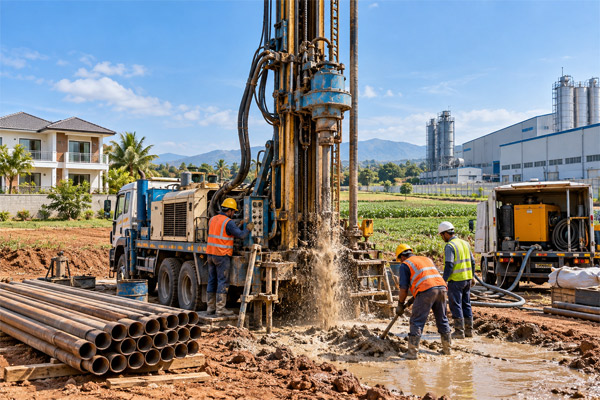
Deep Borewell Drilling for Better Groundwater Access
Deep borewell drilling is used when groundwater is available at a greater depth below the ground. It is commonly required for residential properties, farms, factories, commercial buildings, warehouses, construction sites, and industrial units where normal shallow drilling may not provide enough water.
Quality Borewell provides deep borewell drilling services with proper site checking, suitable drilling equipment, casing support, borewell cleaning, and pump installation assistance.
The exact borewell depth depends on the local ground condition, groundwater level, rock formation, and water requirement.
What Is Deep Borewell Drilling
Deep borewell drilling is the process of drilling deep into the earth to reach underground water-bearing layers.
Compared with shallow borewells, deep borewells may require:
- Heavy-duty drilling machines
- Strong casing pipes
- Proper borewell diameter planning
- Detailed groundwater assessment
- Suitable submersible pumps
- Professional borewell cleaning
When Is a Deep Borewell Required
A deep borewell may be needed when:
A groundwater survey may help before drilling, especially in areas where water availability is uncertain.
Deep Borewell Drilling Process
Site Inspection
The first step is a physical inspection of the property.
The team checks:
- Available drilling space
- Machine access
- Nearby buildings
- Underground utility lines
- Drainage points
- Ground condition
- Proposed water requirement
This helps in planning the drilling work safely.
Groundwater Survey
A groundwater survey can be useful for selecting a suitable borewell location.
It may help identify:
- Probable water-bearing zones
- Geological formations
- Suitable drilling points
- Expected drilling depth
No survey can guarantee water, but it can support better drilling decisions.
Selecting the Borewell Point
The borewell point should be selected carefully.
Important factors include:
- Groundwater potential
- Distance from septic tanks and drainage
- Access for drilling machinery
- Future pump maintenance
- Building foundation
- Existing underground services
Correct placement can reduce future problems.
Drilling to the Required Depth
The drilling machine begins boring through soil, stone, and rock formations.
The contractor monitors the drilling progress and checks for changes in the underground formation.
Drilling continues until a suitable water-bearing zone or planned depth is reached.
Casing Pipe Installation
Casing pipes help protect the borewell wall.
They are especially important in loose soil or unstable formations.
Casing can help:
- Prevent soil collapse
- Reduce entry of loose material
- Support the borewell structure
- Protect upper sections of the bore
The casing length and material depend on site conditions.
Borewell Cleaning
After drilling, dust, mud, and rock particles may remain inside the borewell.
Borewell cleaning helps remove this material.
Proper cleaning may improve:
- Water flow
- Pump performance
- Water clarity
- Long-term borewell operation
Deep Borewell Drilling for Residential Properties
Deep borewells may be used in:
They may support water requirements for:
Water quality testing should be done before using borewell water for drinking.
Deep Borewell Drilling for Industries
Industries may require a larger and more consistent water source.
Deep borewell drilling can support applications such as:
- Manufacturing processes
- Cooling systems
- Equipment cleaning
- Utility water
- Gardening
- Construction work
- Storage tanks
Before drilling, industrial users should estimate their daily water requirement.
This helps in selecting the correct borewell diameter and pump capacity.
Deep Borewell Drilling for Farms
Farmers often depend on groundwater for irrigation.
A deep borewell may support:
- Drip irrigation
- Sprinkler systems
- Crop watering
- Livestock requirements
- Farm utility needs
Groundwater availability should be assessed carefully before investing in deep drilling.
How to Choose a Deep Borewell Drilling Contractor
Before choosing a contractor, check whether they can provide complete support
- Experience in deep borewell drilling
- Knowledge of local geological conditions
- Suitable drilling machinery
- Transparent pricing
- Casing pipe support
- Borewell cleaning service
- Pump installation guidance
- Groundwater survey support
- Repair and maintenance assistance
A professional contractor should explain the work clearly before drilling begins.
Conclusion
Deep borewell drilling is an important solution when groundwater is available at greater depth.
A successful borewell project depends on proper site inspection, suitable drilling equipment, correct casing, cleaning, and pump selection.
For homes, farms, commercial properties, and industrial sites, working with an experienced borewell drilling contractor can help improve drilling quality and long-term performance.
Quality Borewell provides deep borewell drilling and related borewell services for different water requirements in Ahmedabad and surrounding areas.
Frequently Asked Questions
A deep borewell is generally a borewell drilled to a greater depth to reach underground water-bearing formations. The exact depth depends on local geological and groundwater conditions.
There is no fixed depth for every location. Borewell depth varies according to the area, rock formation, groundwater level, and site conditions.
The cost depends on drilling depth, bore diameter, rock type, casing requirement, machine access, cleaning, and pump installation.
A groundwater survey is not always compulsory, but it can help identify a more suitable drilling point and understand the likely underground formation.
A submersible pump is commonly used. The correct pump depends on bore depth, water level, required discharge, and delivery height.
Yes. Deep borewell drilling is commonly used for factories, warehouses, manufacturing units, commercial projects, and construction sites.
Yes. Quality Borewell provides deep borewell drilling and related services for residential, agricultural, commercial, and industrial requirements in Ahmedabad and nearby areas.