
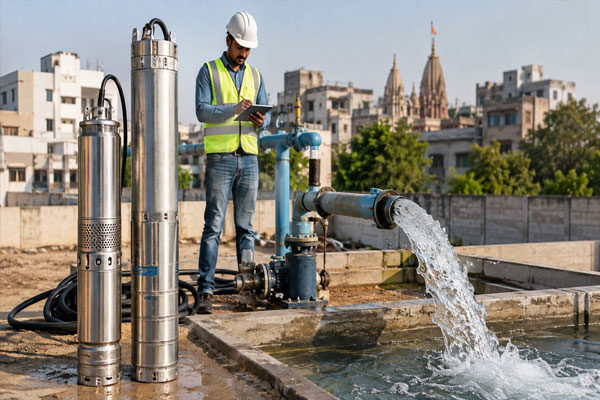
Borewell Submersible Pump in Ahmedabad
A borewell submersible pump is an essential part of any groundwater system. It is installed below the water level inside a borewell and pushes water to the surface for residential, agricultural, commercial and industrial use. Choosing the right pump is important because an incorrect model may result in low water pressure, excessive electricity consumption, frequent breakdowns or motor failure.
People searching for a Borewell Submersible Pump Manufacturer in Ahmedabad need more than just a pump. They require proper pump selection, installation support, pipe fitting, cable connection and after-sales service. Quality Borewell provides complete borewell and submersible pump solutions according to the borewell depth, water level and required discharge capacity.
What Is a Borewell Submersible Pump?
A borewell submersible pump is an electric water pump designed to operate while fully submerged inside a borewell. The pump and motor are connected as a single unit and lowered below the groundwater level.
Unlike surface pumps, a submersible pump does not pull water upward. It pushes water through a delivery pipe, which makes it suitable for deep borewells.
A typical borewell submersible pump system includes:
- Submersible pump and motor
- Column or delivery pipe
- Electrical cable
- Control panel
- Starter and safety devices
- Water-level sensors
- Non-return valve
- Borewell cap and supporting accessories
The capacity of the pump must be selected according to the borewell depth, water yield, pipe size and daily water requirement.
Applications of Borewell Submersible Pumps
Borewell submersible pumps are used in properties where groundwater must be lifted from a considerable depth. They provide consistent water flow when selected and installed correctly.
Common applications include:
- Residential houses and bungalows
- Apartments and housing societies
- Agricultural farms and irrigation systems
- Factories and industrial units
- Commercial buildings
- Schools, hospitals and hotels
- Construction sites
- Warehouses and workshops
- Gardens and landscaping projects
- Water storage tank filling
Different applications require different pump capacities. A domestic property may need a smaller pump, while an agricultural or industrial application may require a high-head and high-discharge model.
How to Select the Right Borewell Submersible Pump
Selecting a pump only on the basis of horsepower is not recommended. Several technical factors must be considered before purchasing or installing a pump.
Borewell Depth
The total depth of the borewell determines the required pump head. A deeper borewell generally requires a pump capable of lifting water through a greater vertical distance.
Static Water Level
The static water level is the depth at which groundwater remains when the pump is not operating. This measurement helps determine the appropriate installation depth.
Dynamic Water Level
The dynamic water level is measured when the pump is running. Water levels may drop during continuous pumping, so this factor is important for preventing dry running.
Water Requirement
The required flow rate depends on the application. Homes, farms, factories and commercial buildings have different water consumption patterns.
Borewell Diameter
The outer diameter of the pump must be suitable for the borewell casing. A pump that is too large may not fit or may become difficult to remove during maintenance.
Delivery Head
The pump must lift water from the borewell and deliver it to an overhead tank, irrigation line or storage area. Horizontal pipe length and building height also affect the required head.
Types of Borewell Submersible Pumps
Domestic Submersible Pumps
Domestic submersible pumps are used for houses, apartments, bungalows and small commercial properties. They are commonly used for filling overhead and underground water tanks.
Agricultural Submersible Pumps
Agricultural pumps are designed for irrigation, farm water supply and continuous operation. They generally require higher discharge and dependable performance.
Industrial Submersible Pumps
Industrial pumps are used in factories, process plants, warehouses and manufacturing units. They are selected according to water demand, operating hours and delivery pressure.
High-Head Submersible Pumps
High-head pumps are suitable for deep borewells, high-rise buildings and locations where water must be delivered over a long vertical or horizontal distance.
Stainless Steel Submersible Pumps
Stainless steel pumps offer corrosion resistance and are suitable for applications that require improved durability and water-contact protection.
Water-Filled and Oil-Filled Pumps
Submersible motors may be water-filled or oil-filled, depending on the design. The right option should be selected according to operating conditions, servicing requirements and borewell application.
Benefits of Borewell Submersible Pumps
A properly selected borewell submersible pump offers several practical advantages.
Efficient Water Lifting
Because the pump operates below the water level, it pushes water upward efficiently and is suitable for deep borewells.
Quiet Operation
Submersible pumps operate underground, which reduces noise compared with many surface-mounted pumping systems.
Space-Saving Installation
The pump is installed inside the borewell, so it does not occupy significant space around the property.
Consistent Water Pressure
An appropriately sized pump can provide dependable flow for tank filling, irrigation and daily water use.
Reduced Priming Problems
Submersible pumps do not usually require manual priming because they remain submerged during operation.
Suitable for Different Applications
They are available in different horsepower, head and discharge ranges for residential, agricultural and industrial applications.
Frequently Asked Questions
The suitable pump depends on borewell depth, water level, borewell diameter, required discharge and delivery height. A technical inspection is recommended before selection.
Horsepower requirements vary according to depth and water demand. Domestic systems may need lower horsepower, while agricultural and industrial systems may require higher-capacity pumps.
Yes. High-head submersible pumps are designed for deep borewells. The pump must be selected according to the total lifting head and operating water level.
Low discharge may be caused by a falling water level, blocked pump stages, pipe leakage, low voltage, worn components or reduced borewell yield.
The pump should remain below the dynamic water level but should not touch the bottom of the borewell. The exact installation depth depends on site conditions.
Yes. A suitable control panel helps operate the pump safely and may provide overload, voltage and dry-run protection.
Quality Borewell provides support for pump selection, supply, installation, replacement and borewell-related services in Ahmedabad.
The pump should be inspected when water flow reduces, electricity consumption increases or unusual tripping occurs. Preventive checks can help detect problems early.
Not always. Residential and agricultural applications usually have different head, discharge and operating-hour requirements.
The cost depends on horsepower, pump type, head range, material, installation depth, pipe length, cable and control-panel requirements.