
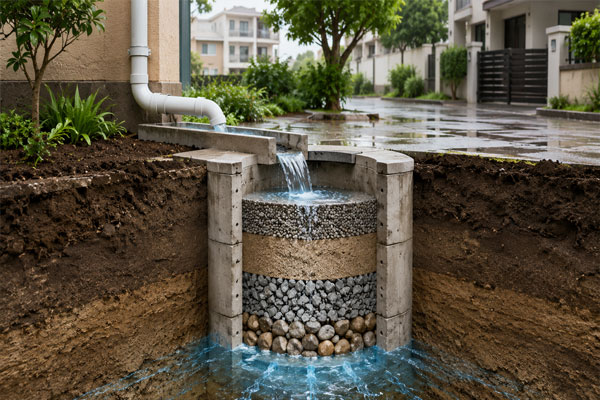
Percolation Well in Ahmedabad for Groundwater Recharge
Rapid construction, paved surfaces, and irregular rainfall have reduced the amount of rainwater that naturally enters the ground. As a result, many residential, commercial, and industrial properties experience falling groundwater levels, waterlogging, and increased dependence on external water sources.
A properly designed Percolation Well in Ahmedabad helps collect rainwater and direct it into suitable underground soil layers. It supports groundwater recharge, reduces surface runoff, and improves rainwater management around the property.
Quality Borewell provides percolation well construction services for residential societies, farms, factories, commercial buildings, institutions, warehouses, and development projects. Our team with 50 years of industry experience plans each solution according to site conditions, available space, rainfall flow, soil type, and recharge requirements.
What Is a Percolation Well?
A percolation well is a specially constructed underground structure that allows collected rainwater to gradually seep into the surrounding soil.
Rainwater from rooftops, paved areas, internal roads, and open spaces is directed toward the well through suitable pipes or drainage channels. Before entering the well, the water may pass through a filtration arrangement to remove leaves, mud, sand, and other unwanted particles.
The stored water then slowly moves into the surrounding ground and supports the natural recharge process.
Why Is a Percolation Well Needed in Ahmedabad?
Ahmedabad receives seasonal rainfall, but a large amount of rainwater flows into roads and drainage systems instead of entering the ground. Concrete surfaces, buildings, parking areas, and paved compounds reduce natural water absorption.
A percolation well can help properties manage this rainwater more effectively.
It may support:
- Groundwater recharge
- Reduced rainwater runoff
- Better stormwater management
- Lower waterlogging risk
- Improved use of rooftop rainwater
- Reduced pressure on drainage systems
- Better long-term water conservation
- Support for existing borewells and recharge systems
How Does a Percolation Well Work?
Rainwater Collection
Rainwater is collected from rooftops, terraces, internal roads, parking areas, and open spaces.
Water Transportation
Pipes, gutters, or channels carry the collected water toward the percolation well.
Initial Filtration
A filter chamber helps remove leaves, plastic, silt, sand, and other solid waste before the water enters the well.
Water Storage
The filtered rainwater temporarily collects inside the percolation well.
Ground Infiltration
Water gradually passes through the bottom and side areas of the well into suitable soil layers.
Groundwater Recharge
The infiltrated water supports underground moisture and may contribute to the local groundwater recharge process.
Applications of Percolation Wells
Residential Societies
Housing societies can use percolation wells to manage rainwater collected from terraces, roads, gardens, and common areas.
Individual Homes and Bungalows
A compact percolation well can help utilise rooftop rainwater and reduce water accumulation around the property.
Industrial Facilities
Factories, warehouses, workshops, and industrial sheds often have large roof and paved areas that produce heavy rainwater runoff.
Commercial Buildings
Hotels, hospitals, malls, offices, and retail buildings can use percolation wells as part of their rainwater management system.
Agricultural Farms
Farms can use percolation structures to support groundwater recharge and improve rainwater conservation.
Schools and Institutions
Educational campuses, hospitals, government buildings, and public facilities can collect rainwater from large roofs and open areas.
Main Components of a Percolation Well
A standard system may include:
- Rainwater collection pipes
- Gutter or drainage channels
- Silt trap
- Filter chamber
- Percolation chamber
- Perforated structure
- Gravel and stone layers
- Inspection cover
- Overflow arrangement
- Maintenance access
Difference Between a Percolation Well and a Recharge Well
| Percolation Well | Recharge Well |
|---|---|
| Allows water to seep through nearby soil | Directs water toward deeper underground layers |
| Commonly used where soil has suitable absorption | Used where deeper recharge is required |
| May be constructed at moderate depth | Usually planned based on geological conditions |
| Supports gradual water infiltration | Supports more targeted groundwater recharge |
| Design depends on surface runoff and soil type | Design depends on deeper formation and water level |
Benefits of Installing a Percolation Well
Supports Groundwater Recharge
The main purpose of a percolation well is to allow rainwater to enter suitable underground soil layers.
Reduces Surface Runoff
It helps control the volume of rainwater flowing across roads, compounds, and open spaces.
Helps Control Waterlogging
A properly planned system may reduce rainwater accumulation in low-lying areas of the property.
Makes Better Use of Rainwater
Instead of allowing rainwater to leave the site, the system redirects it toward underground recharge.
Supports Existing Borewell Systems
Groundwater recharge structures may support the surrounding underground water environment over time, although results vary according to local conditions.
Reduces Drainage Pressure
Managing rainwater within the property can reduce pressure on municipal or internal stormwater drainage lines.
Why Choose Quality Borewell?
- 50 Years of Groundwater Industry Experience
- Practical Experience in Percolation Well Projects
- Technical Expertise in Groundwater Recharge
- Site-Specific Percolation Well Planning
- Trusted Percolation Well Service Provider
- Established Expertise in Borewell and Recharge Solutions
- Transparent Site Assessment and Recommendations
- Solutions Based on Actual Project Requirements
- Long-Term Performance-Focused Solutions
Frequently Asked Questions
A percolation well collects filtered rainwater and allows it to gradually enter the surrounding soil for groundwater recharge.
Yes, Quality Borewell provides percolation well planning and construction services for residential, commercial, agricultural, and industrial properties in Ahmedabad.
It directs filtered rooftop and surface rainwater into suitable underground soil layers instead of allowing it to flow into drains.
It can be installed in housing societies, bungalows, factories, warehouses, farms, schools, hospitals, and commercial buildings.
The size depends on the property’s catchment area, rainfall flow, soil condition, available space, and expected recharge requirement.
Yes, a filter chamber helps remove mud, leaves, sand, and other waste before rainwater enters the well.
Yes, rooftop rainwater can be directed through suitable pipes and filters into the percolation well.
The pipes, silt trap, and filter chamber should be inspected and cleaned before every monsoon and whenever water flow reduces.