
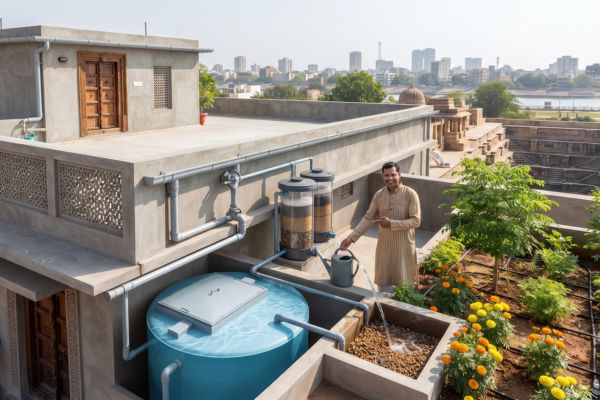
Rooftop Rainwater Harvesting in Ahmedabad for Water Conservation
Water conservation is becoming increasingly important for homes, apartments, commercial buildings, factories, schools, and other properties. Rooftop Rainwater Harvesting in Ahmedabad provides a practical way to collect rainwater from building roofs and use it for groundwater recharge or suitable non-drinking purposes.
Instead of allowing rainwater to flow into roads and drainage systems, a properly planned rainwater harvesting system directs rooftop water through pipes, filters, and recharge structures. Quality Borewell provides rainwater harvesting solutions designed according to property size, rooftop area, site conditions, and water conservation requirements.
What Is Rooftop Rainwater Harvesting
Rooftop rainwater harvesting is a method of collecting rainfall that falls on the roof of a building. The collected water is carried through gutters and pipes to a filtration system.
After filtration, the water can either be stored in a suitable tank or directed into a recharge well, recharge pit, percolation well, or borewell recharge system depending on site conditions.
The basic system may include:
- Rooftop catchment area
- Gutters and rainwater pipes
- First flush arrangement
- Rainwater filter
- Recharge or storage structure
- Overflow arrangement
The exact design depends on the available rooftop area, rainfall, soil conditions, existing borewell, available space, and intended use of collected water.
Why Rooftop Rainwater Harvesting Is Important in Ahmedabad
Ahmedabad experiences seasonal rainfall, with a significant amount of rain arriving during the monsoon months. A large quantity of rooftop rainwater can be lost as surface runoff when buildings do not have a suitable collection or recharge system.
Installing a rainwater harvesting system in Ahmedabad can help property owners make better use of this seasonal rainfall.
Rather than allowing clean rooftop runoff to immediately enter stormwater drains, rainwater harvesting provides an opportunity to manage water at the property level.
For suitable properties, filtered rainwater can also support groundwater recharge. The effectiveness of recharge depends on local soil, geology, groundwater conditions, system design, and maintenance.
How Does a Rooftop Rainwater Harvesting System Work
The process starts when rainfall lands on the building roof. Gutters and downpipes collect the water and direct it toward the harvesting system.
A first-flush arrangement can divert the initial runoff, which may contain dust and other contaminants accumulated on the rooftop. The remaining water then passes through an appropriate filtration system.
Depending on the project design, filtered water can be directed to:
- A storage tank
- Recharge pit
- Recharge well
- Percolation well
- Existing borewell recharge arrangement
A professional assessment is important before selecting the recharge method because every site has different ground conditions and available space.
Recharge Well for Rainwater Harvesting
A recharge well is designed to help suitable rainwater move below the ground instead of being lost as surface runoff.
Recharge wells can be considered for residential societies, commercial buildings, industrial properties, educational campuses, institutions, and other sites with adequate rooftop catchment areas.
The depth, diameter, filtration arrangement, and construction of a recharge structure should be determined according to site conditions rather than using the same design for every property.
Quality Borewell can assess project requirements and recommend an appropriate recharge well in Ahmedabad based on the property and intended recharge application.
Percolation Well in Ahmedabad
A percolation well is another structure that can be used as part of a groundwater recharge system. Its purpose is to allow collected and suitably filtered rainwater to gradually enter permeable ground layers.
Percolation systems may be useful where the soil and subsurface conditions support infiltration.
Before constructing a percolation well in Ahmedabad, factors such as available area, soil conditions, expected runoff, rooftop size, and drainage arrangement should be evaluated.
Proper filtration is also important because excessive sediment entering the structure can reduce its performance over time.
Borewell Recharge Using Rooftop Rainwater
Properties with an existing borewell may explore borewell recharge as part of their rainwater management strategy.
In such systems, rooftop rainwater should not simply be connected directly to a borewell. Appropriate first-flush, filtration, and recharge arrangements are important to reduce the entry of leaves, dust, sediment, and other contaminants.
Whether an existing borewell is suitable for recharge should be determined after evaluating the site’s conditions.
A properly planned borewell recharge system in Ahmedabad can form part of a broader groundwater conservation strategy.
Rooftop Rainwater Harvesting for Residential Properties
Homes, housing societies, apartments, and residential complexes can use rooftop harvesting to manage monsoon runoff.
A residential system can be planned according to:
- Total rooftop area
- Number of rainwater outlets
- Available open space
- Existing borewell
- Storage requirements
- Ground conditions
- Expected rainfall runoff
For apartments and housing societies with large terrace areas, the potential rooftop catchment can be significant.
Rainwater Harvesting for Industries and Commercial Buildings
Factories, warehouses, offices, hospitals, hotels, schools, and commercial complexes often have larger roof areas. These properties may therefore collect substantial quantities of rainwater during suitable rainfall events.
An industrial rainwater harvesting system may incorporate multiple collection points, larger filters, recharge structures, storage arrangements, and overflow management.
The system should be designed around actual roof area and site conditions rather than using a standard capacity for every industrial project.
Benefits of Rooftop Rainwater Harvesting
A properly designed rooftop harvesting system can provide several benefits.
It can reduce the amount of rooftop water immediately discharged as surface runoff, support groundwater recharge where conditions are suitable, provide an alternative water source for appropriate non-potable uses, and improve overall rainwater management at a property.
Rainwater harvesting also encourages homes and businesses to use available natural water resources more responsibly.
Maintenance of a Rainwater Harvesting System
Installing a system is only the first step. Regular maintenance is essential for reliable operation.
Rooftops and gutters should be cleaned before the monsoon. Filters should be inspected and cleaned periodically, while first-flush arrangements should remain operational.
Recharge wells and pits should also be checked for sediment accumulation or blockage. Regular maintenance helps maintain water flow and extends the useful life of the system.
Choose Quality Borewell for Rooftop Rainwater Harvesting in Ahmedabad
Quality Borewell provides solutions for Rooftop Rainwater Harvesting in Ahmedabad, including rainwater recharge planning and suitable recharge structures according to project requirements.
Whether the requirement is for a residential property, apartment, commercial building, industrial facility, school, or other site, the system should be planned after understanding rooftop area, drainage, ground conditions, and recharge objectives.
Professional planning helps create a practical rainwater harvesting solution rather than simply diverting rooftop water underground.
Conclusion
Rooftop Rainwater Harvesting in Ahmedabad is a practical approach to managing seasonal rainfall and supporting responsible water conservation. Rooftop runoff can be collected, filtered, and directed toward storage or suitable groundwater recharge structures instead of being completely lost through surface drainage.
Solutions such as recharge wells, percolation wells, recharge pits, and borewell recharge systems can be considered based on site-specific conditions. Quality Borewell can help property owners plan an appropriate rainwater harvesting solution for residential, commercial, and industrial requirements.
Frequently Asked Questions
A professional should first evaluate your rooftop area, rainwater outlets, available space, soil conditions, existing borewell, and intended use before recommending a suitable system.
It may be possible at suitable sites, but rainwater should be properly collected and filtered, and the borewell and local conditions should be evaluated before designing a recharge arrangement.
Both can support groundwater recharge, but their construction and suitability depend on soil, geology, available space, runoff quantity, and project requirements.
The potential quantity depends mainly on rooftop area, rainfall and the runoff characteristics of the roof. A site assessment can be used to estimate the amount available for harvesting.
Yes. Housing societies and apartments can have large combined rooftop areas, making them suitable candidates for rainwater collection and recharge systems when site conditions allow.
Yes. Factories and warehouses often have large roof areas. A system can be designed for storage, recharge, or a combination based on the site’s requirements.
Yes. Rooftops, gutters, filters, first-flush systems, recharge pits, and wells should be inspected and cleaned periodically, especially before and during the monsoon.