Professional Soil Testing Services for Better Site Decisions
Soil testing services help property owners, builders, industries, farmers, and contractors understand the condition of the land before starting construction, borewell drilling, foundation work, or other site development.
The soil below a property can vary in strength, moisture, density, composition, and load-bearing capacity. A proper soil test gives useful information that can reduce unexpected problems during construction or drilling.
Quality Borewell provides soil testing support for residential, commercial, industrial, agricultural, and borewell-related projects.
What Are Soil Testing Services
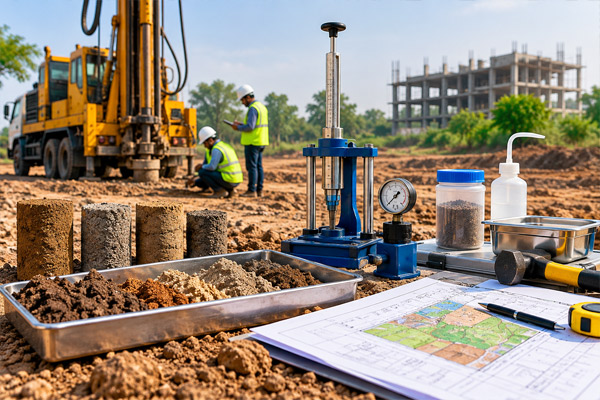
Soil testing is the process of examining soil samples to understand their physical and engineering properties.
Depending on the project, testing may help identify:
- Soil type
- Moisture content
- Density
- Compaction
- Bearing capacity
- Soil layers
The results help engineers and contractors make better decisions before work begins.
Why Soil Testing Is Important
Starting construction or drilling without understanding the soil can increase the risk of structural and site-related problems.
Soil testing can help with:
Testing does not remove all project risks, but it provides important information before major investment begins.
Soil Testing Before Construction
Soil testing is commonly carried out before constructing:
- Houses
- Apartments
- Factories
- Warehouses
- Commercial buildings
- Industrial sheds
- Schools
- Hospitals
- Boundary walls
Soil Testing for Borewell Planning
Soil testing can also support borewell-related work.
- Selecting drilling equipment
- Planning casing requirements
- Identifying loose soil layers
- Understanding ground stability
- Preparing the drilling area
- Reducing bore collapse risk
However, soil testing is different from a groundwater survey. A groundwater survey focuses on probable underground water-bearing formations, while soil testing focuses on soil and ground properties.
Common Types of Soil Testing
Soil Classification Test
This test helps determine whether the soil mainly consists of:
- Clay
- Sand
- Silt
- Gravel
- Mixed material
Soil classification is useful for understanding how the ground may behave under load or during excavation.
Moisture Content Test
This test measures the amount of water present in the soil.
High or low moisture levels can affect:
- Compaction
- Strength
- Excavation
- Foundation behavior
Soil Density Test
Density testing helps understand how closely soil particles are packed.
It is commonly useful for:
- Flooring
- Road construction
- Backfilling
- Industrial yards
- Foundation preparation
Compaction Test
Compaction testing checks whether soil has been compacted properly.
It is useful for:
- Factory floors
- Roads
- Parking areas
- Foundations
- Filling work
- Industrial civil work
Bearing Capacity Test
Bearing capacity refers to the ability of soil to safely support structural loads.
This information is important for foundation design.
Weak soil may require deeper foundations or ground improvement.
Soil Testing Process
Site Inspection
The first step is to inspect the site and understand the project requirement.
The team may check:
- Total plot size
- Proposed construction
- Ground condition
- Existing structures
- Excavation requirements
- Borewell location
- Access for testing equipment
Soil Sample Collection
Samples are collected from selected locations.
The number and depth of samples depend on the project type and site size.
Laboratory Testing
Samples may be tested for required properties such as:
- Moisture
- Density
- Soil classification
- Strength
- Compaction
- Bearing capacity
Result Analysis
The results are reviewed to understand the condition of the soil.
The findings may then be used by engineers or contractors for project planning.
Soil Testing for Residential Projects
Homeowners may require soil testing before constructing:
Soil Testing and Groundwater Survey Are Different
| Soil Testing | Groundwater Survey |
|---|---|
| Studies soil properties | Studies probable groundwater conditions |
| Helps with foundation planning | Helps with borewell point selection |
| Checks density and strength | Evaluates water-bearing zones |
| Useful for construction | Useful before borewell drilling |
| Focuses on soil behavior | Focuses on underground water potential |
When Should You Get Soil Testing Done
Soil testing should be considered when:
- Planning a new building
- Constructing a factory
- Installing heavy machinery
- Developing a warehouse
- Preparing industrial flooring
- Starting major excavation
- Planning deep foundation work
- Developing new land
- Beginning borewell-related civil work
- Soil condition is unknown
Soil Testing Services in Ahmedabad
Ahmedabad has different types of soil and development conditions across residential, industrial, and expanding suburban areas.
Construction projects in areas with mixed soil conditions may require proper testing before foundation or heavy civil work begins.
Quality Borewell provides soil testing support for different types of projects in Ahmedabad and nearby locations.
The service can be useful for:
- Residential construction
- Industrial projects
- Commercial buildings
- Borewell planning
- Land development
- Factory foundations
- Warehouse projects
Borewell Maintenance Tips
Simple maintenance can improve borewell performance.
- Check pump performance regularly
- Avoid continuous dry running
- Inspect electrical connections
- Clean the borewell when discharge reduces
- Repair damaged pipes quickly
- Test water quality periodically
- Keep the borewell area clean
- Consider recharge systems where suitable
Factors That Affect Soil Testing Cost
The cost of soil testing depends on several factors.
| Factor | Effect on Cost |
|---|---|
| Site size | Larger sites may need more sampling |
| Number of test points | More points can increase testing cost |
| Sampling depth | Deeper sampling may require more work |
| Type of test | Specialized tests may cost more |
| Site access | Difficult access may increase effort |
| Laboratory analysis | Detailed testing can affect the total cost |
| Project type | Industrial projects may require more data |
A site-specific quotation is usually more accurate than a fixed rate.
Conclusion
Soil testing services are an important part of construction, industrial development, land planning, and some borewell-related projects.
Testing helps identify soil type, density, moisture, strength, and other ground conditions before work begins.
Quality Borewell provides soil testing support for residential, commercial, industrial, and land development projects in Ahmedabad and nearby areas.
For better project planning, soil testing should be completed before foundation work, heavy construction, or major ground development starts.
Frequently Asked Questions
Soil testing helps understand the ground condition and provides information that can support safe foundation and structural planning.
Depending on the requirement, it may check soil type, moisture, density, compaction, strength, and bearing capacity.
It can be useful even for smaller residential projects, especially where soil conditions are unknown or foundations need proper engineering.
Yes, it can help understand upper soil conditions and casing requirements, but groundwater survey is more suitable for identifying probable water-bearing zones.
The cost depends on site size, sampling depth, number of test points, type of testing, and laboratory requirements.
Yes. Industrial projects often need soil information for foundations, flooring, machine bases, and heavy structural loads.
Yes. Quality Borewell provides soil testing support for residential, commercial, industrial, and site development projects in Ahmedabad and nearby areas.